Mixture of Experts (MoE) Explained
If you have watched the AI field over the last few years, you have probably noticed a tension that never quite goes away. The most capable models keep getting larger, and larger models keep getting more expensive to run. Every extra parameter can make a model a little smarter, but it also makes every response a little slower and a little pricier. For a long time the industry simply accepted this trade-off and threw more hardware at it.
Mixture of Experts, usually abbreviated as MoE, is one of the most important ideas for loosening that trade-off. It is the reason some of the largest models in production can feel surprisingly fast and cheap to query. This article explains what MoE is, how it works under the hood, where it struggles, and why it matters to you even if you never train a model yourself.
The problem: bigger models, bigger bills
To understand why MoE exists, it helps to look at how a standard (often called "dense") neural network handles a request.
In a dense model, every parameter participates in producing every output. When you send a prompt, the entire network lights up. If the model has 70 billion parameters, then generating each token requires computation proportional to all 70 billion of them. Doubling the model's capability by doubling its size also doubles the compute cost of every single word it writes.
This is a painful dynamic. Most of the knowledge stored in those parameters is not relevant to any given query. When you ask a model to debug a Python function, the parameters that know French poetry and the parameters that know medieval history are still dragged through the calculation, doing no useful work but consuming time and memory.
Researchers kept asking the same question: what if a model could be large overall, but only activate the part of itself that is relevant to the current input? That question is exactly what MoE answers.
What is Mixture of Experts?
Mixture of Experts is an architecture where a model contains many separate sub-networks — the "experts" — and a learned mechanism decides which few of them should handle each piece of input.
The key insight is the separation between two quantities that a dense model keeps locked together:
- Total parameters: how much knowledge the model can store in principle.
- Active parameters: how much computation is actually used for a given token.
In a dense model these are always equal. In an MoE model they are decoupled. A model might have 200 billion total parameters spread across many experts, but only activate 20 billion of them for any single token. You get the breadth of a very large model with the running cost of a much smaller one.
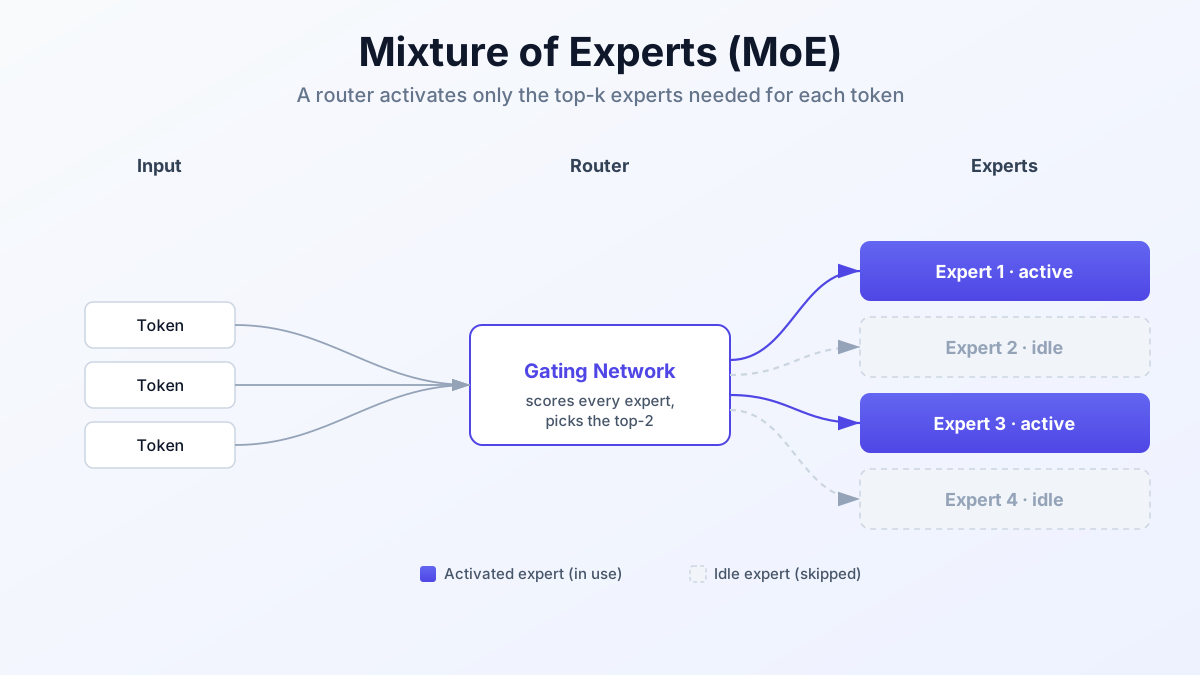
This is called sparse activation, and it is the heart of why MoE is attractive. The diagram below shows the basic shape of the idea.
How the router works
The component that makes sparsity possible is called the router, or gating network. It is a small neural network in its own right, and its only job is to make a routing decision.
Here is the flow for a single token:
- The token arrives and is turned into a vector (a list of numbers representing its meaning in context).
- The router looks at that vector and outputs a score for every expert in the model.
- The scores are compared, and only the top few experts — often the top 2 — are selected. This is the "top-k" choice you will see in MoE papers.
- The token is sent to those selected experts. The rest sit idle for that token.
- The outputs of the selected experts are combined, weighted by how confident the router was in each one, and the result continues through the rest of the network.
The router is trained end-to-end along with everything else. No one hand-wires which expert handles which input; the model learns the division of labor on its own. Over the course of training, experts tend to specialize — one might quietly become better at syntax, another at factual recall, another at step-by-step arithmetic — but this specialization emerges rather than being prescribed.
Dense vs. sparse: where the speed comes from
The practical payoff of sparsity is easiest to see by comparing two hypothetical models with the same total knowledge:
- A dense 70B model activates all 70 billion parameters per token.
- An MoE model with 200 billion total parameters but only 20 billion active per token.
The MoE model has far more stored knowledge (more parameters overall), yet each token it generates is cheaper to compute than the dense model's. From the user's perspective, the response arrives faster. From the provider's perspective, each conversation costs less to serve. That gap is what makes ambitious free tiers and low-latency chat products economically viable.
It is worth being precise about one common confusion: an MoE model is not smaller in memory. All of its experts must live in memory at once, because any of them might be needed at any moment. What MoE saves is compute, not storage. This distinction matters a lot for the trade-offs discussed next.
The trade-offs nobody mentions
MoE is not a free lunch, and the caveats are worth knowing if you want to judge AI claims critically.
Memory pressure. Because every expert must reside in memory, an MoE model can be demanding to host. A model with a modest active-parameter count can still require substantial VRAM. This is why you rarely see very large MoE models running on a single consumer GPU.
Training difficulty. Training an MoE model is harder than training a dense one of the same size. The router and the experts have to learn to cooperate, and small instabilities early in training can compound. Researchers invest heavily in tricks to keep training stable.
Routing collapse. A classic failure mode is "routing collapse," where the router sends almost everything to a handful of favorite experts and leaves the rest starving. When that happens, the model effectively shrinks back toward a dense model and loses its efficiency advantage. Load-balancing techniques — which nudge the router to distribute work more evenly — are essential to prevent it, and they add engineering complexity.
Finetuning fragility. Dense models are relatively forgiving when you adapt them to a new task. MoE models can be touchier: finetuning can destabilize the routing patterns the model learned during pretraining, sometimes degrading quality in surprising ways.
None of these are reasons to avoid MoE; they are reasons it tends to be used by teams with serious infrastructure. The architecture is powerful, but it earns its gains through real engineering effort.
Hybrid architectures: MoE meets new paradigms
MoE is most powerful when combined with other ideas, and the current frontier is full of "hybrid" models that splice several techniques together.
One active direction mixes MoE with alternative sequence-modeling backbones. Standard Transformers process text through attention, which is expressive but grows expensive as conversations get longer. Researchers have been experimenting with architectures based on state-space models (such as the Mamba family) and linear attention, which handle long sequences more cheaply. A hybrid model might use such a backbone for the bulk of its layers and reserve full attention for the places where it earns its cost — then layer MoE on top so that each layer is also sparse.
The appeal is multiplicative: cheaper long-context handling and cheaper per-token computation. The cost is complexity. These hybrid MoE designs are genuinely harder to train, tune, and serve, and the research is still moving quickly. If you read marketing for a model that advertises a "hybrid" architecture, the honest translation is usually "we combined several efficiency techniques and it worked," not "we invented one magic ingredient."
What this means for everyday users
You do not need to care about routers or experts to benefit from them. The user-facing consequences of MoE are concrete:
- Faster responses. Less computation per token means the first word appears sooner and streaming feels snappier.
- Cheaper free tiers. When each request costs the provider less, free or generous tiers become sustainable. A model that would be uneconomical to give away in dense form can be offered freely when it is sparse.
- Longer conversations. Combined with efficient backbones, sparse activation makes it less punishing to hold long context windows, so you can paste in more code or more document text without the model choking.
- More variety at the top. Because capability-per-dollar improves, smaller labs can field competitive models, which means more choice and more downward pressure on prices.
Trying it yourself
Reading about sparse activation is one thing; feeling the latency difference is another. The clearest way to understand MoE is to use a model built around it and pay attention to how quickly it responds relative to how much it seems to know. You can experiment with a Nemotron 3 model in the playground and judge the speed-to-capability balance directly.
Conclusion
Mixture of Experts is not a gimmick; it is a foundational shift in how large models are built. By letting a model be large in total but small in active computation, MoE breaks the old assumption that smarter must mean slower and more expensive. The architecture comes with real costs — memory footprint, training difficulty, routing pitfalls — but for the largest models in production, the trade has proven worth it again and again.
For anyone who uses AI chat tools, the takeaway is simple: when a large model feels surprisingly fast or surprisingly cheap, there is a decent chance a router somewhere just decided which experts to wake up. Understanding that one mechanism makes a lot of the modern AI landscape suddenly make sense.